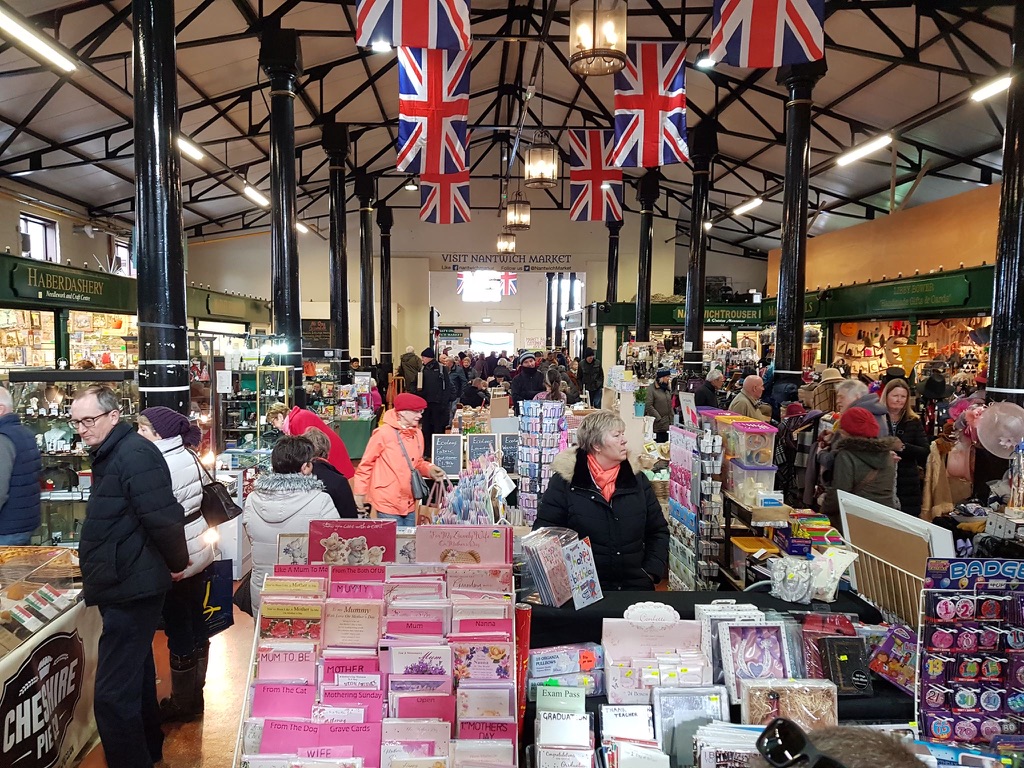
A wander around Nantwich indoor Market Hall on a Saturday morning is a weekly ritual for lots of Dabbers. Buy your fresh veg, egg and fish, get that picture framed that you’ve been meaning to do for ages and get your shattered phone screen replaced all in one place! With not a big high-street brand in sight, it evokes memories of a slower paced, by-gone age where stall holders know all of their regulars by name and stopping for a chat is a part of it’s appeal. It’s easy to see why it was included in a list of top 10 markets in the UK.
However, the current Market Hall, which opened in 1868, was built to replace an even older Market Hall which was right on the main square.
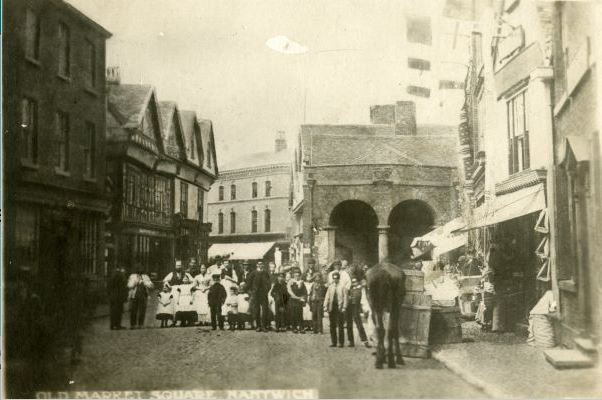
This photo, probably taken in the 1860s, is one of the few images that we have of the old Market Hall (which was known as The Booth Hall). In the centre of the image is the hall which stands in what is now the square where lots of markets are still held to this day. To the left, Nantwich Book Shop and behind the hall are a row of several buildings, all long gone.
This incarnation of the Market Hall was built in 1720. The historian James Hall wrote in his 1883 work ‘A history of the town and parish of Nantwich, or Wich-Malbank, in the county palatine of Chester’:
This Market Hall, which met with the requirements of the town until 1868, was a low building in the High Town, opposite Castle Street. Its roof was supported by brickwork on semicircular arches that rested on nine granite columns ; the only ornament being a plume of feathers (the badge of the Prince of Wales) on the cornice above the central pillar on the south side.
– Hall 1868
However, It wasn’t always a low building. Originally the building was constructed with a ‘sessions’ room above, essentially an upstairs room which was used for various meetings and events. This mult-use space gave rise to several names for the structure – The Booth Hall, The Courthouse, Town Hall, Public Hall, Assembly Rooms and, of course, Market Hall. James Hall records the building being used for court hearings, election polls, grand dinners and public meetings as well as the sale of goods on the ground floor.
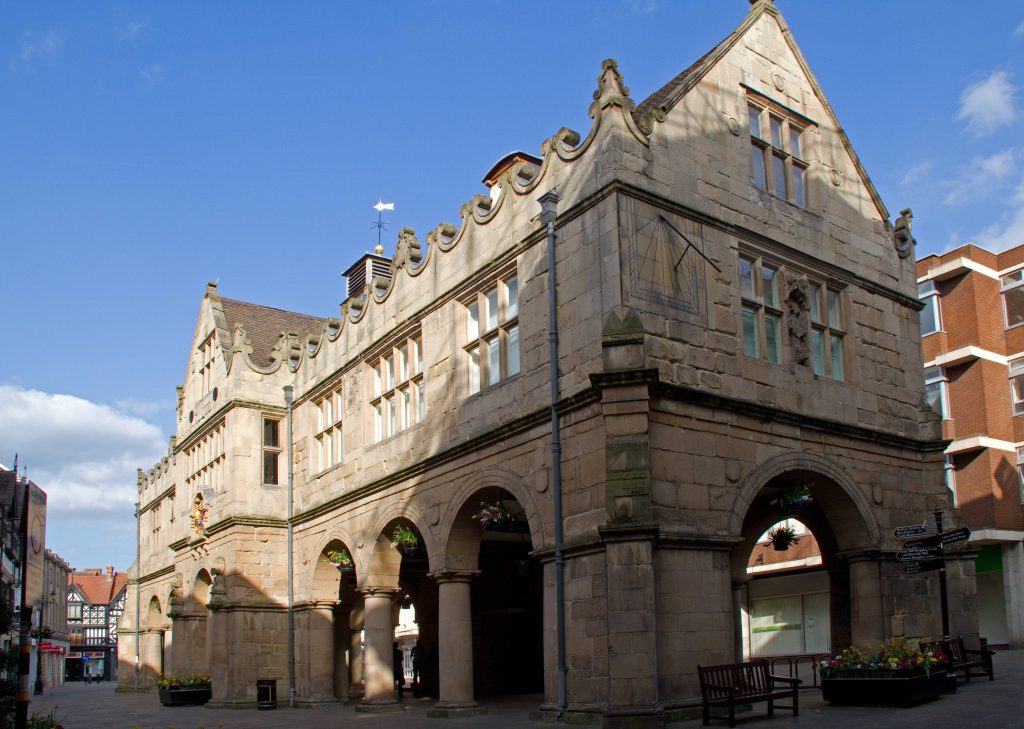
Tony Hisgett from Birmingham, UK, Shrewsbury 9 (7048676077), CC BY 2.0
Towards the erection of this Market Hall, with a Sessions Room above, in 1720, George Frederick, Prince of Wales, Earl of Chester, etc, (afterwards King George III) gave £600 ; and a full figure of the Prince, carved in gritstone, ornamented the South side of the building
– Hall 1868
Unfortunately, on 14th May 1737, just sixteen and a half years after its construction, the building collapsed and nine people were killed. The death toll could have been much higher had the tragedy happened earlier in the day with the streets busy with townsfolk.
The Hall was rebuilt but disaster struck once again in 1759:
While the Justices were holding their Sessions, a sudden crash so greatly alarmed the court that in the hurry and confusion of getting down, many people, expecting the whole fabric to fall every moment, were much hurt.”
– Partridge’s History of Nantwich.
Due to these incidents the upstairs rooms were removed the following year, however, the market area below was retained and this is the state in which we can see the building in our photo above.
The building served as the town’s main market for over 100 years after this point and was eventually demolished in 1868 after the opening of the new (and current) Market Hall on Churchyardside and the newly constructed Market Street.
Then and now…
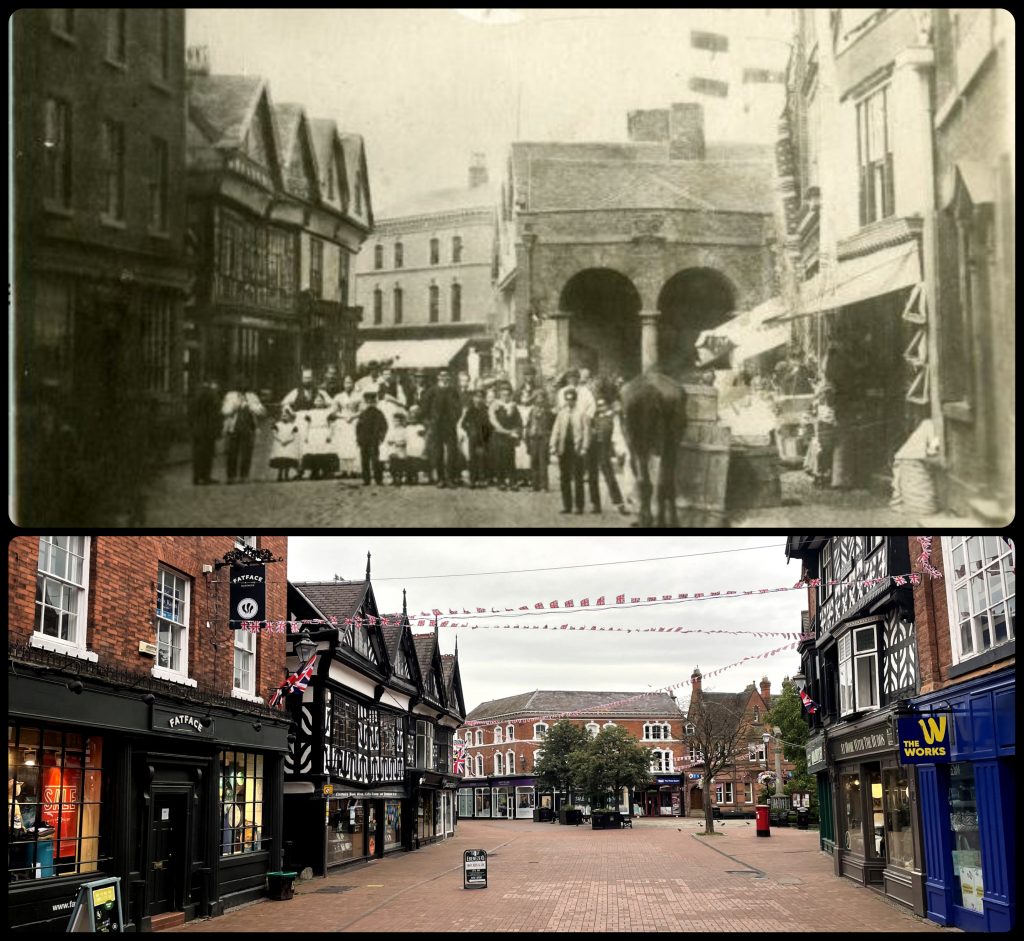
Flags are flying in both our Then and Now photos. Now it’s to celebrate the recent coronation of King Charles III, the Great-great-great-great-great-great Grandson of the man who paid for the original building back in 1720!